Ask most people shopping for oceanfront land in Loreto what they need to close and they'll say the same thing: a fideicomiso, a good notary, and enough patience for the bank trust paperwork. That answer is correct and also incomplete. It covers the dirt. It says nothing about the twenty meters of sand between that dirt and the water, which in Mexico belongs to the nation and is governed by an entirely separate federal permit that has to exist, be current, and be transferred to you by name before you can call any part of that beach yours to use.
In Loreto's El Bajo neighborhood, it isn't unusual to see raw oceanfront lots marketed with a beach concession already bundled into the sale, alongside a Mexican corporation and permits still working their way through the system. That packaging tells you something true about this market: the concession is treated as a separate asset from the land itself, one that has to be sourced, verified, and sometimes waited on, rather than something that simply comes with the deed. Buyers who treat the fideicomiso as the finish line are skipping the step that actually determines whether the water view comes with usable water access.
The Trust Covers the Lot. A Different Agency Covers the Sand.
The fideicomiso is the mechanism that lets a foreign buyer hold property in Mexico's restricted coastal zone, and in Loreto it works the way it does across Baja California Sur: a Mexican bank acts as trustee, the buyer holds full beneficial rights to sell, rent, renovate, or pass the property to heirs, and the trust renews in 50-year terms. Setup typically runs $2,000 to $3,000 USD with an annual fee of $500 to $1,000, folded into closing costs that generally land between 4 and 6 percent of the purchase price across acquisition tax, notary fees, and registry filing.
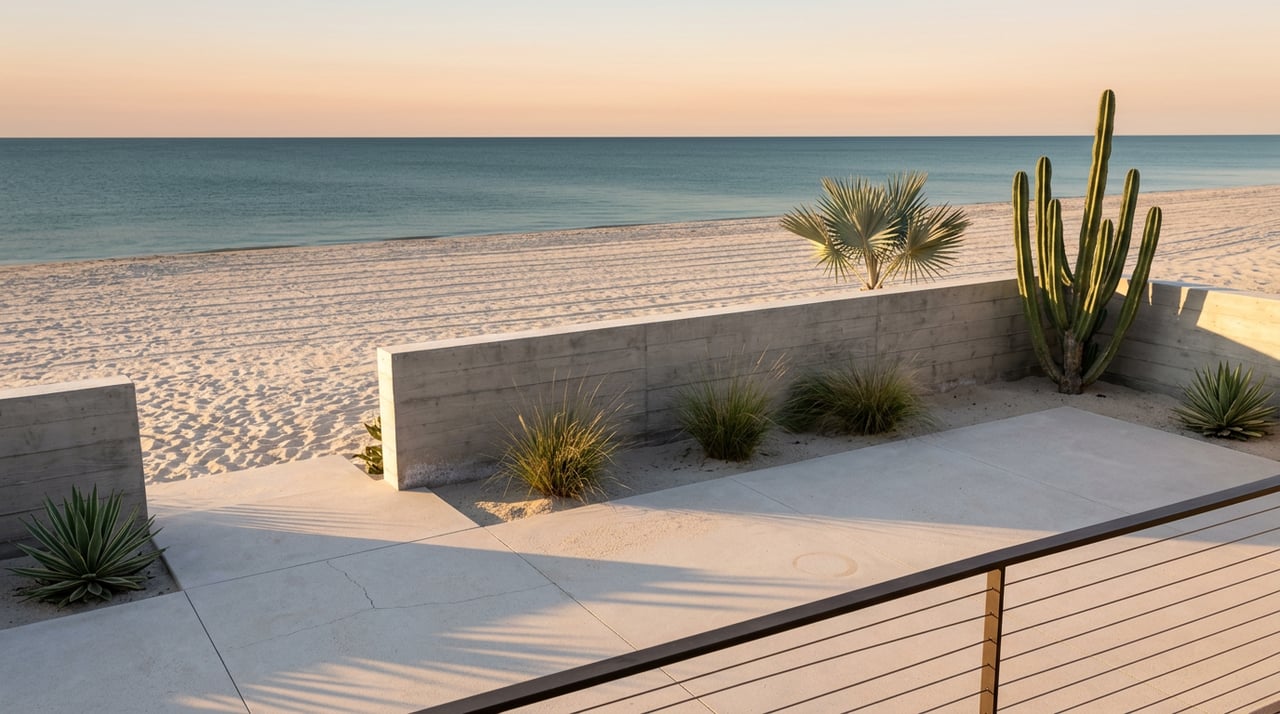
None of that touches the beach. The Federal Maritime Terrestrial Zone, known as ZOFEMAT, is a 20-meter strip measured from the high tide line, and it's federal public property under Mexican law, administered by SEMARNAT through its coastal zone directorate, with PROFEPA verifying compliance. Mexican law explains it plainly: owning the upland lot through a trust does not give you the concession for the strip in front of it. The concession is a separate federal title, one that has to be current, correctly mapped, and assigned into your name at closing, not assumed because it's mentioned in a listing.
Two Clocks That Don't Run Together
Here's the part that trips up even careful buyers. The fideicomiso renews on its own 50-year cycle. The ZOFEMAT concession has its own separate 50-year term, and under Mexican federal rights law the holder only has a preferential claim to renew during the final 10 percent of that term, not automatically, not indefinitely. These are two different administrative clocks attached to the same property, running on separate tracks, and a concession that's quietly lapsed doesn't get fixed just because your trust is in good standing.
A trust that's current tells you nothing about whether the beach concession attached to that same lot is current too. They are separate filings with separate expiration risk, and only one of them shows up when a title company checks the property.
This matters most in Loreto precisely because so much new waterfront supply is entering the market at once. Costa Loreto's beachfront parcels, the Waicuri lots at Marina Puerto Escondido, and Danzante Bay's Mantarraya Residences represent genuinely new inventory rather than resales, which means many of the concessions tied to these properties are freshly filed. New isn't automatically clean. It just means there's less transaction history to lean on if something was filed incorrectly the first time.
What Happens If the Concession Lapses or Was Never Properly Assigned
The stakes aren't abstract. Building on the federal zone without a valid concession, or letting one expire and continuing to use the strip, exposes the owner to cancellation and PROFEPA sanctions. Mexican legal counsel notes that obstructing public access to the beach, something a lapsed or improperly used concession can invite scrutiny over, carries penalties up to 12 years in prison and fines that can reach roughly $14,500 USD. Federal reforms in 2020 reinforced that beach access has to stay open regardless of who holds a concession on the adjacent strip, and enforcement of that principle has only gotten more consistent since, even if it still varies by location.
None of this means a concession is worthless or that Loreto waterfront property is riskier than any other coastal market in Mexico. It means the concession is a document with a status, and that status needs to be checked with the same seriousness buyers already apply to the trust itself.
How This Plays Out Differently Across Loreto's Waterfront
The concession question doesn't look the same in every part of Loreto's market. Where you're buying changes what you need to ask.
| Submarket | How beach access is typically structured | What to verify before closing |
|---|---|---|
| El Bajo raw oceanfront lots | Concession sometimes bundled with the sale, sometimes still in process | Whether the concession already exists in the seller's name, or whether you'd be applying for it yourself after closing |
| Loreto Bay / Nopoló | Master-planned community with shared beachfront | Whether your HOA agreement grants you use of a community-level concession, which is not the same as holding one individually |
| Danzante Bay | Resort-anchored oceanfront residences along the golf course | The resort operator likely holds the master concession; confirm what rights, if any, pass to individual lot owners |
| Waicuri at Marina Puerto Escondido | Private docks on individual parcels | Marina infrastructure permits and ZOFEMAT beach concessions run on separate regulatory tracks; a dock right is not a beach concession |
A lot with a private dock and a lot with unrestricted golf-course beachfront can both be described as waterfront in a listing, and both require entirely different verification depending on whether the concession lives with an individual owner, a resort operator, or a homeowners' association.
A Closing Checklist Built for One Specific Lot
Generic due diligence advice tells you to check title. On a Loreto beachfront lot, that advice needs to be more specific:
- Ask for the concession's title number and confirm with the seller or developer that it's currently paid and not at risk of cancellation
- Get the survey or plan that shows exactly where the private lot ends and the federal 20-meter strip begins, since marketing photos rarely draw that line accurately
- Confirm no existing construction, walls, palapas, or docks already encroach on the federal strip, since that exposure transfers to you at closing
- Have your closing attorney or notary confirm in writing how and when the concession will be assigned to you, not just that one "exists"
- Remember that even with a valid concession, you cannot legally block public passage across the beach itself, so plan any privacy or security features around that constraint rather than against it
Baja California Sur has between 25 and 30 licensed notaries, and the notary's job in any Loreto transaction includes verifying the identity and authority of each party, drafting the transfer document, collecting the applicable taxes, and recording the transaction at the public registry. A good notary will ask about the concession as a matter of course. A good buyer asks before the notary has to.
Questions Worth Asking Before You Wire Funds
Does a fideicomiso automatically include the beach concession in front of the lot? No. The trust secures the upland property. The concession for the federal zone is a separate filing with SEMARNAT and has to be verified and assigned on its own.
If the concession has lapsed, can it just be renewed? Sometimes, but not automatically and not guaranteed on the same terms. A lapsed concession is a gap in continuity, and reapplying carries its own timeline and uncertainty, which is why checking status before closing matters more than assuming it after.
Can I still use the beach even if there's no concession at all? Yes. The strip is federal public land, and access can't legally be blocked by any private owner, concession holder, or developer. A missing concession limits what you can build or operate on that strip, not whether you or anyone else can walk on it.
Loreto's waterfront market is growing quickly enough that median home and condo prices have climbed roughly 60 percent since 2021, with transaction volume reaching a four-year high in 2025. That pace rewards buyers who move fast and punishes the ones who skip a step because everyone else seems to be closing without trouble. The trust protects the lot. The concession protects your right to use what's in front of it. Treat them as two separate questions, because in Loreto, they are.
If you're evaluating a specific waterfront lot in Loreto and want a second set of eyes on the concession before you commit, Apex Real Estate Los Cabos can walk the details with you. Schedule a private consultation and bring the listing.